
Inito Review: My TTC Journey Through Loss and Conceiving Naturally
Inito Review: My TTC Journey Through Loss and Conceiving Naturally
Quick Take:
After two losses and months of confusing, inconclusive LH strip results, Inito showed me I was ovulating all along; my surge was just lower than standard strips are built to catch. Tracking all four key hormones (not just LH) gave me real confirmation instead of guesswork, and I used it to conceive my daughter, Millie. Now, trying again, I'm using the Inito Fertility Monitor that is now standalone, wireless, and easy to fit into my mornings. Especially helpful if your LH surge runs low or your cycles feel unpredictable.
Inito helped me understand my hormones and what’s happening in my body. But to know how Inito helped, let me first take you through my journey.
I didn’t think I’d ever talk about this casually. Not after everything it took to get here.
Before Millie, there were two losses. And in between those moments, there was a kind of uncertainty that’s hard to explain unless you’ve lived it. Not just the grief, but the not knowing.
Wondering if your body is doing what it’s supposed to do. Wondering if you’re missing something. Wondering if you’re trying at the wrong time without even realizing it.
It felt like I was showing up fully… without any real clarity. And over time, that starts to wear on you.
Finding Inito changed that for me in a way I didn’t expect.
Not in a dramatic, overnight way, but in a steady, grounding way that gave me something I hadn’t really had before: visibility into what my body was actually doing.
For the first time, I wasn’t guessing. I could see my patterns. I could understand my timing. I could confirm what was happening instead of hoping I was reading it right.
And that shift changed my entire experience of trying to conceive. It brought a sense of calm back into something that had started to feel heavy.
I used Inito to conceive Millie.
And now, coming back to it again as we step into this next season of family planning, it feels less like trying something new… and more like returning to something that already supported me when I needed it most.
If you’ve been searching for honest Inito reviews, wondering whether multi-hormone tracking is worth it, or looking for a fertility monitor that provides more clarity than traditional ovulation strips, this post shares my honest experience with Inito - through loss, through conceiving my daughter, and now as I use it again, trying for our next.
What Is Inito and How Does It Work?
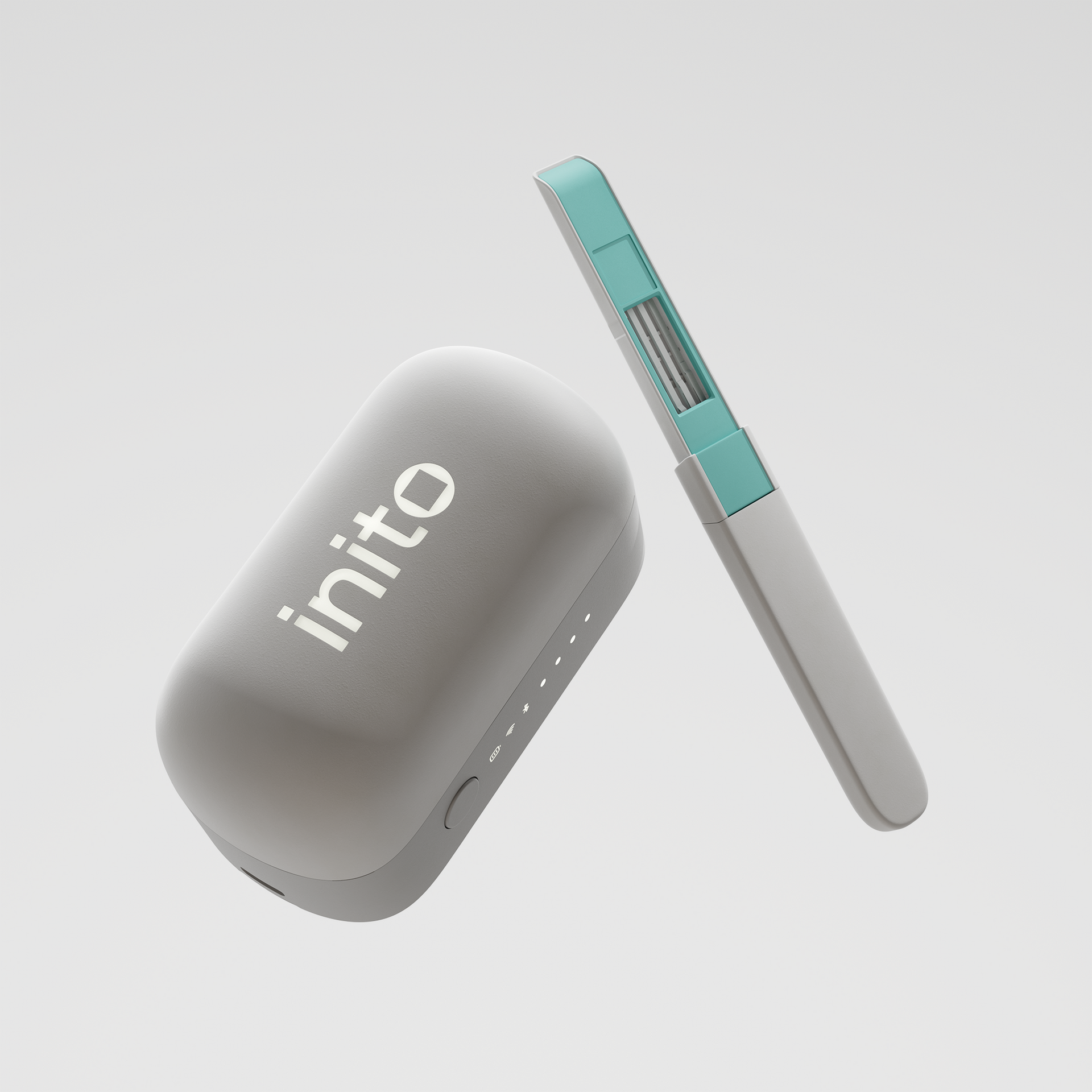
Inito is an at-home fertility monitor that now comes with a standalone wireless reader, built-in Wi-Fi, and a more streamlined testing experience, making it noticeably easier to integrate into everyday life. Unlike traditional ovulation tests that focus on LH alone, Inito measures four key fertility hormones on a single test strip:
- Estrogen (E3G) - rises before ovulation and helps identify the start of your fertile window
- Luteinizing Hormone (LH) - surges before ovulation and helps predict your most fertile days
- PdG (Pregnanediol Glucuronide) - a urine metabolite of progesterone that rises after your true LH surge to confirm that ovulation actually happened
- Follicle Stimulating Hormone (FSH) - supports follicle growth
What I didn’t fully appreciate until I used it consistently is that it tracks four key fertility hormones together, which actually means: instead of trying to "catch the right day," you can see your full 6-day fertile window unfold, understand when ovulation is approaching, and then confirm that it happened afterward.
That confirmation piece is what changed things for me. It replaced so much second-guessing with a quieter sense of confidence.
The process to test with Inito is simple, so it doesn’t interrupt your day. You dip the Fertility Strip into your first morning urine, insert it into the Inito reader, and go about your morning. The device syncs results directly to your phone, so you can exit the app if you need to do something, check a work email, or doom scroll a little.
And then about 10 minutes later, your results are already waiting in the app. That small shift, being able to step away, made a real difference.
The wireless syncing made the process feel even more convenient, removing one more layer of friction from daily hormone tracking. It fits into my morning routine with ease and turned something that used to feel like a task into something that quietly supports you in the background.
Whether I’m getting ready, moving through the house, or just starting the day, it doesn’t ask me to stop everything.
How Accurate Is the Inito Fertility Monitor?
Inito Fertility Monitor delivers precise hormone readings using its patented Spectral Mapping technology - a dual-sensing system that scans the entire Fertility Strip rather than a single test line, capturing measurable hormone data at multiple points. This means it can pick up subtle shifts in hormone levels that a standard strip would miss entirely, giving you results you can actually trust from the comfort of your home.
What reassures me most is that the precision isn't just a feeling - it's backed by data. The readings feel consistent, and the trends make sense.
And over time, that consistency becomes something you rely on, not because it tells you what to do, but because it shows you what’s already happening. Because the reader performs the analysis itself rather than relying on manual strip interpretation, it creates a more precise and consistent experience.
Clinical studies have also shown Inito is
95% accurate compared to blood testing and confirms ovulation with over
99% specificity. Knowing the system was not only scientifically designed but also clinically validated made it much easier for me to trust the data I was seeing at home.
Why I Chose Inito Again for Hormone Tracking
When we started trying to conceive again, I didn’t want to rely on guesswork.
Not because my body is unpredictable, but because it’s actually very specific. And I’ve learned that if I’m not paying attention to the full picture, it’s easy to misread what’s happening.
Before using Inito for the first time, I relied on LH strips. And for a while, I thought they just weren’t working for me.
I kept getting results that suggested I wasn’t ovulating at all. I didn’t see any dark lines on my ovulation tests. Cycle after cycle, it felt confusing and honestly discouraging, like my body wasn’t doing what it was supposed to do.
But that wasn’t true.
I was ovulating, which I confirmed using Inito. I realized that my surge sits lower than what most standard ovulation strips are designed to pick up. Most ovulation tests measure LH levels between 20 and 40 mIU/ml, and mine was lower than this average threshold.
My body was doing what it was supposed to. I just didn’t have the right tools to clearly understand what my hormones were actually doing.
And that gap made it much harder to actually time things well enough to get pregnant.
What I needed wasn’t more effort. I needed something that could actually meet my body where it is.
That’s what led me to Inito in the first place. It gave me far more clarity than traditional LH strips ever did, and it’s also why I came back to it again. Instead of relying on a simple yes-or-no result, I was able to see real hormone data and understand how my hormones were actually moving throughout my cycle.
Rather than depending only on population-average thresholds, Inito helped me see patterns based on my own hormone trends, which made the experience feel much more personalized to my body.
Having used it across two full cycles now, what stands out isn’t just the data; it’s the patterns. Once you start seeing your own hormone trends, things begin to feel clearer in a way that’s hard to explain until you experience it.
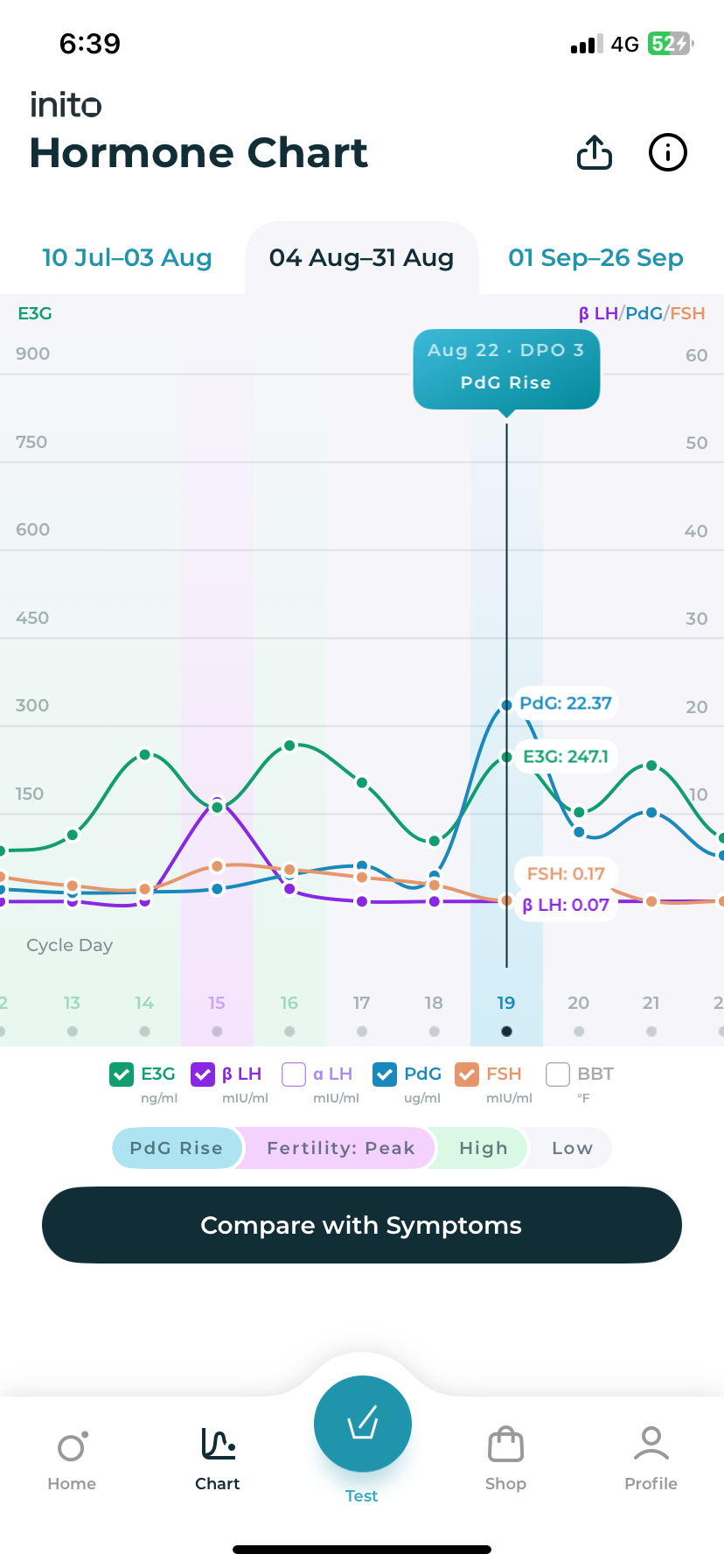
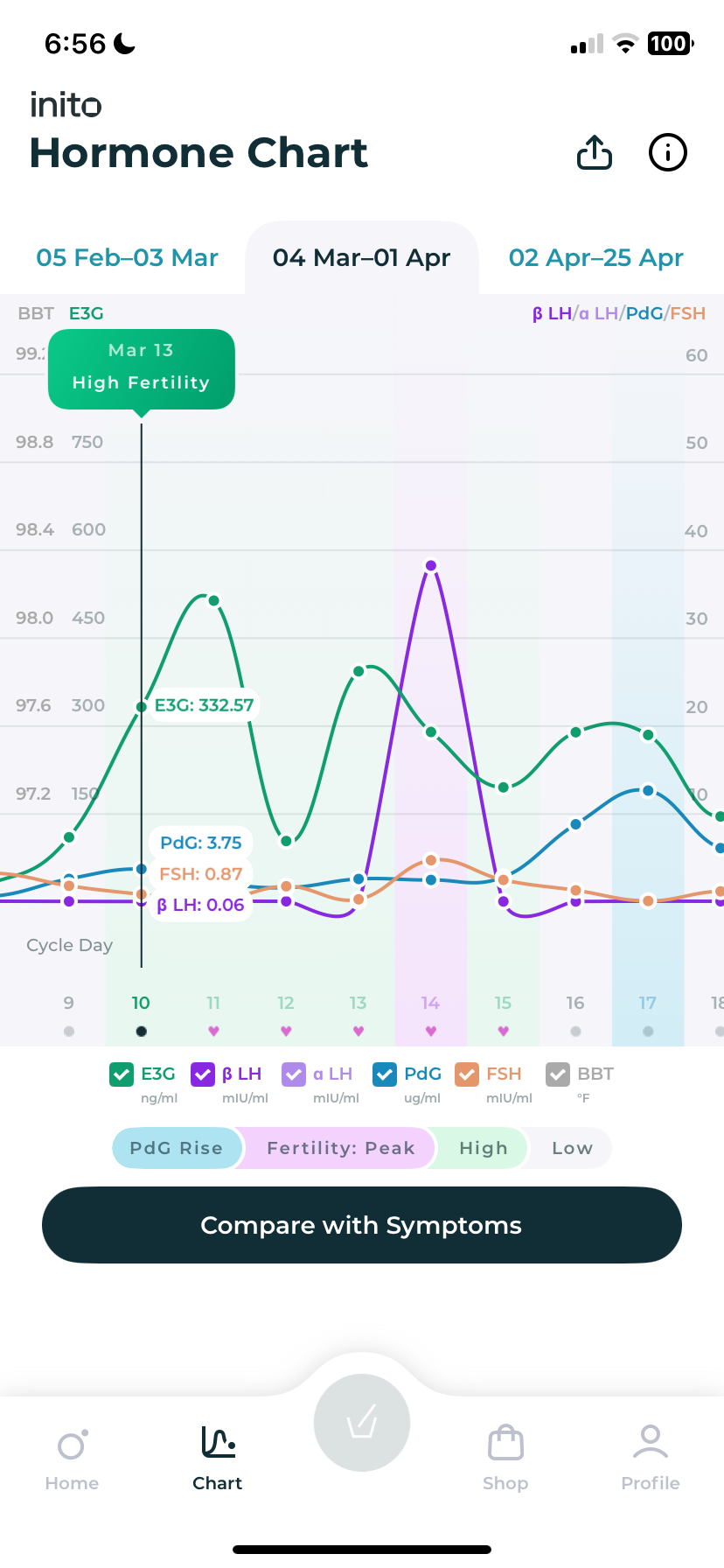
In one cycle, I could see my estrogen start rising on cycle day 13, two days before my LH surge on day 15. That earlier rise gave me a clearer view of when my fertile window was beginning, rather than having to wait for an LH surge to know I was already in it. Then, around day 18, I could see my PdG start rising consistently, giving me evidence that ovulation had actually occurred - not just that an LH surge had happened. Seeing that progression - estrogen rising, then LH surging, followed by a PdG rise - all in one chart gave me a level of visibility into my cycle that LH-only strips never could. That changed how I thought about timing. There’s something grounding about seeing how your hormones are actually functioning rather than assuming where they are in your cycle.
| Features | LH Strips / OPKs | Inito |
|---|---|---|
| What it measures | LH surge only, against a population-average threshold (typically 20–40 mIU/ml) | 4 key hormones - estrogen (E3G), LH, FSH, PdG - based on your own hormone trends |
| Predicts fertile window | Yes, roughly 1–2 days | Yes - full 6-day window |
| Confirms ovulation | No | Yes, via PdG |
| Ease of use | Test, then interpret how dark the line is | Dip, insert, walk away |
| Result type | +/− or one line vs. two | Actual hormone values + full-cycle charts |
The Inito App Experience
The Inito app is where everything comes together.
You can see:
- Clear hormone charts across your cycle
- Full 6-day fertile window or the knowledge of the right days to try
- Ovulation confirmation
- Personalized insights based on your patterns
It doesn’t feel generic or one-size-fits-all. The app clearly labeled each stage of my cycle as High Fertility, Peak Fertility, or Ovulation Confirmed, which made it incredibly easy to understand where I was without having to interpret hormone levels on my own.


The charts can also be shared with a doctor, which adds another layer of support if you’re navigating questions or wanting deeper insight.
“As a physician, understanding a patient’s full hormone pattern is essential for optimizing fertility care,” said Dr. Lora Shahine, double board-certified OB, GYN, reproductive endocrinologist, and Advisor at Inito. “That’s what stands out to me about Inito. Unlike lab tests that provide a snapshot of a single point in time, Inito tracks hormone changes throughout the cycle, giving a complete view of what’s happening in the body. It confirms ovulation, identifies the best days to conceive, and allows both patients and physicians to see trends over time, including improvements from medications or lifestyle changes. This continuous insight empowers patients to make informed choices while helping physicians fine-tune care, creating a more personalized and confident fertility journey.”
You can also use it as a diary, making notes on your emotions, activities, and intimate moments with your partner. Log your symptoms daily on the app and see how they relate to your hormones. This makes it easy to come back and check what happened when, without having to recall what you wore or ate that day to jolt a memory.
Is Inito Worth It? Price, Cost, and Accessibility
The Inito Fertility Monitor, is priced at $169 and is currently available at $109 as part of the launch offer. It's also HSA/FSA eligible, so you can put pre-tax dollars toward it.
Compared to many advanced fertility monitors, Inito offers a more affordable way to track four key fertility hormones at home while providing significantly more insight than LH-only strips. It’s one of the more accessible options when it comes to multi-hormone tracking at home. You can use my link here to get a discount. Or you can use code ALISOND at checkout.
And for me, having used it through one pregnancy and now returning to it again, it feels less like a one-time purchase and more like something that can support me whenever I need it. So if you're asking whether Inito is worth it - for me, the answer has always been yes.
Pros and Cons of Inito: What I Liked and What to Know
What I’ve liked:
- Being able to step away while it runs
- Seeing my 6-day fertile window instead of isolated results
- The confirmation of ovulation
- Precise hormone results I could genuinely trust
- How naturally it fits into a normal routine
What’s worth knowing:
- There is a small learning curve at the beginning
- It works best when you follow the testing schedule recommended in the app, which usually starts around cycle day 6 (with cycle day 1 being the first day of your period)
- It’s different from traditional strips, so it may take a little time to fully understand your patterns
- You need to remember to take a sample of your first pee. Try not to go on autopilot in the morning.
None of this felt overwhelming, just part of becoming more aware.
Where Inito Fits Into My TTC Journey Now
I don’t use Inito from a place of urgency anymore. I’m not trying to force timing or control something that doesn’t need to be controlled.
But I do care about being aware. About showing up to this season with clarity instead of confusion.
For me, that’s what Inito has offered, both the first time and now again. No pressure. Just peace. Peace in knowing our journeys unfold in their own timing, but knowing what’s going on inside my body helps bring ease to what can sometimes be a stressful season.
If you’re starting your trying-to-conceive journey and want more clarity, confidence, and peace in understanding your hormones, Inito offers deeper insights that traditional ovulation tracking often misses. In a journey that can feel emotionally complex, that kind of visibility can make all the difference.
Frequently Asked Questions About Inito: What I Wanted to Know Before Using It
Is Inito an ovulation predictor or a hormone tracker?
It’s a hormone tracking monitor that gives a full view of your cycle, not just ovulation timing, while also confirming if ovulation occurred.
How often do you need to test?
Consistency helps, especially through your fertile window, but it doesn’t feel excessive once it becomes part of your routine. You need to start testing from cycle day 6 until you get ovulation confirmation. Take a test as and when the app tells you.
Can it work with PCOS and irregular cycles?
Yes, because it tracks your hormones directly, rather than relying on predicted averages. It can be even more helpful for irregular cycles, since it follows your actual hormone patterns in real time instead of assuming ovulation will happen on a “typical” cycle day.
Do you have to use the first morning urine?
That’s what’s recommended for the most consistent readings.
Can results be shared with a doctor?
Yes, the charts are easy to export and share, which makes those conversations with your doctor more informed. You can read more information on that here.
Does Inito work on Android and iOS?
Yes, since April 2026, Inito Fertility Monitor works with both Android and iOS.
Is Inito better than ovulation strips?
For many women, especially those with irregular cycles, Inito may provide more comprehensive insights than traditional ovulation strips by tracking multiple fertility hormones instead of LH alone. Inito not only predicts your fertile window by tracking estrogen, LH, and FSH, but it also confirms that you ovulated by tracking the rise in PdG.